Designing Measurable Skill Through Play
Turning gameplay into meaningful, trackable outcomes
Players often enjoy games for fun, but in training and simulation, the challenge is designing experiences that teach and measure skill simultaneously. I led the creation of gameplay systems that quantified performance while keeping the experience intuitive, engaging, and motivating.
Problem / Goal
-
Clients needed systems to measure real-world skills through interactive experiences: soft skills like communication, and hard skills like technical inspections or equipment handling.
-
Key challenge: Translate gameplay into reliable metrics while maintaining immersion and fun.
-
Goals:
-
Track skill progression quantitatively
-
Provide immediate, understandable feedback
-
Maintain a game-like experience, avoiding the feel of a test
-
Approach / Methodology
-
Designed mechanics that naturally produce measurable data:
-
Success/failure events
-
Task completion time
-
Accuracy and precision
-
-
Built real-time feedback loops to inform players of performance without breaking immersion
-
Prototyped and iterated in Unity and Unreal refining play feel and measurement fidelity
-
Collaborated with engineers and subject matter experts to ensure metrics were valid and actionable
Virtual Humans
-
Created VR training for conversational skill development
-
Designed the VR conversational system allowing players to have voice-based interactions with NPCs
-
Evolved into an AI-backed conversation system using Watson, providing more dynamic conversational flows
-
Focused on measurable indicators such as response accuracy, timing, and engagement
Technical Training
-
Home Inspection Simulation: Gamified FPS-style interactions to identify water damage, procedural map generation for new floorplans each run, scoring accuracy of inspection decisions
-
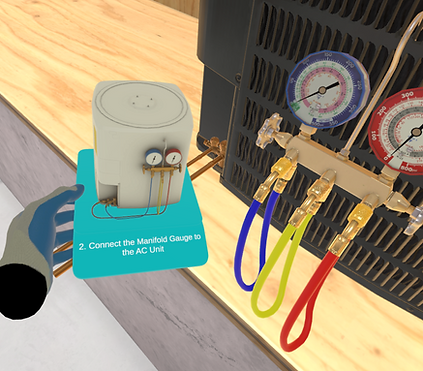
HVAC Repair Training: Accurate, interactive simulations of HVAC equipment, including hoses, manifold gauges, and multimeters, tracking both efficiency and correctness


Outcome / Impact
-
Skills were measured faster and more reliably than traditional methods (PwC study: 400% faster learning, 375% more engaging)
-
Metrics could be directly tied to real-world performance, giving clients actionable insight
-
Players remained immersed and motivated, demonstrating learning without feeling “tested”
Key Takeaways
-
Game mechanics can be designed to generate meaningful, measurable data without sacrificing engagement
-
Real-time feedback is essential for motivation and understanding
-
Cross-disciplinary collaboration (design, engineering, research) ensures playability and validity